

Notice: Time - includes short stops at traffic lights, studying the map, etc.
| Day | 8. |
| Date | 29.9.2001 |
| Distance [miles] | 21,6 |
| Time | |
| Average speed [miles/hour] | |
| Total Distance [miles] | 234,8 |
Today was Kevin's last working day. We decided to climb Mt. Whitney together, so during the morning I visited the Alabama Hills.
These hills are west of Lone Pine, and a 20 km uphill road winds through them to Whitney Portal. At Whitney Portal (2,744 m), the John Muir Trail begins its climb towards the summit of the highest mountain in the "lower 48" - Mt. Whitney (4,418 m).
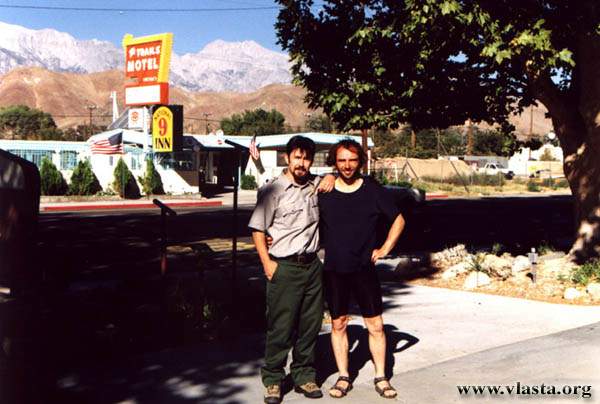
At 6 p.m., Kevin was finally ready to go. There was a full moon, and because the trail did not cross particularly difficult terrain, we hiked without flashlights. That way, we could see more and enjoy the beauty of the tall rocks bathed in moonlight and the deep silence around us. But the whole trek was demanding. The one-way distance to the summit was about 35 km, with an elevation gain of around 2 km. We kept passing hikers who were already on their way back. When we reached the first campground - Outpost Camp - we were still in good spirits and good condition. "OK, let's continue to the next camp," Kevin said. "It's not that far." We passed Mirror Lake. After another hour, I was getting tired, so I asked Kevin how much farther it was. I could not believe it - a ranger who had been working here for more than four months had hiked this trail only once, and that had been at night. After what seemed like an endless time, we finally saw a few tents ahead. Uff! We slept at Trail Camp. This campground is also the last place with water, although the water has to be boiled or treated before drinking. That night, I slept at the highest elevation I had ever slept at - 4,000 m - after hiking 13.6 km by moonlight.
| Day | 9. |
| Date | 30.9.2001 |
| Distance [miles] | 16 |
| Time | |
| Average speed [miles/hour] | |
| Total Distance [miles] | 250,8 |
Mt. Whitney is probably one of the most popular mountains to hike in the USA. For this reason, the number of people allowed to climb it is restricted by the rangers. You can get a free permit in Lone Pine. The limit is 150 people for day hikes and 50 for overnight hikes. Overnight hikers can stay at either Trail Camp or Outpost Camp. If you are camping in the wilderness, you should use a BRFC - bear-resistant food container, which can be bought or rented at the ranger station. Black bears live in this area. On weekends, people usually have to wait for a permit because of the high demand. Mt. Whitney is located in Sequoia National Park, and the last 5 km of the John Muir Trail follow the eastern border of the park. I can definitely recommend climbing this mountain.
| Day | 10. |
| Date | 1.10.2001 |
| Distance [miles] | 77.13 |
| Time | 6:38:37 |
| Average speed [miles/hour] | 11,7 |
| Total Distance [miles] | 328 |
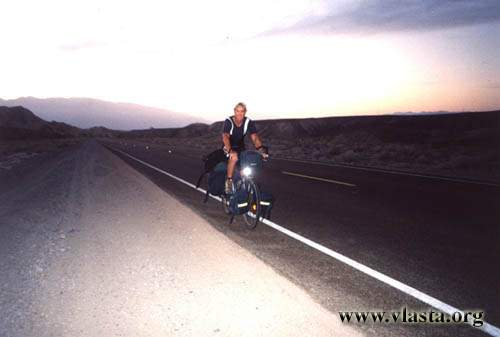
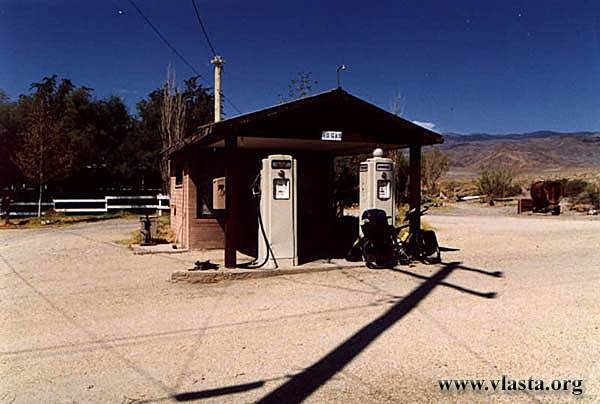
After three days of gathering information and thinking about my next destination, I had to make a decision. A ranger told me, "It is going to get colder for the next three days." Well, if I had brought a bike, I should use it. I decided not to rent a car for Death Valley and to go there by bike instead. I bought an extra bottle of water, and at the post office in the small village of Keeler, I filled all my bottles. Altogether, I had 7.5 litres of water. A notice at an abandoned gas station said, "No Gas"....
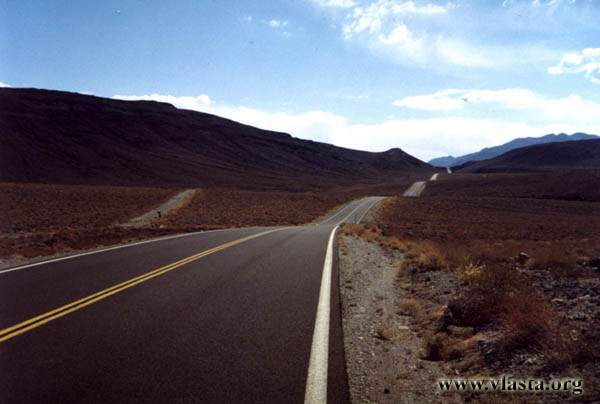
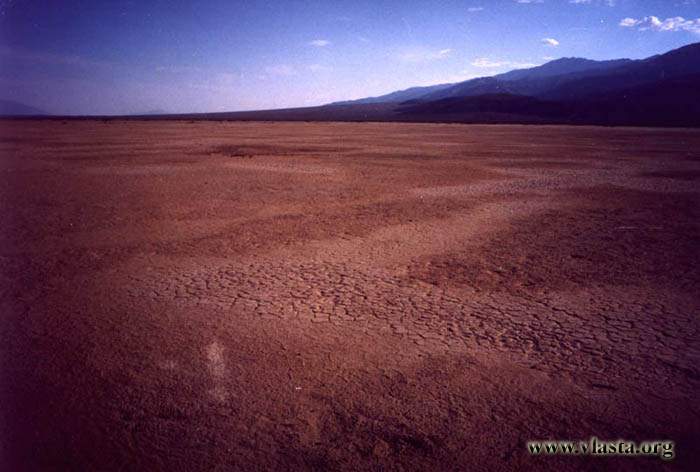
Death Valley National Park is much larger than Death Valley itself. The park also includes the Panamint and Amargosa ranges. So before I could reach the actual "Death Valley", I had to cross several long climbs, including a 17 km ascent from Panamint Valley to Towne Pass with an elevation gain of about 1 km. It was very hot even there, and I had to rest for an hour in the shade behind a large rock. I returned to the road around sunset. The sky was clear, and my friend the moon lit my way. I wanted to camp at Emigrant Camp, which I knew from an earlier trip. Using my lowest gear, I kept going. On the final part of the climb, I simply walked my bike because my speed was about the same. After another half hour, I could finally feel that I was reaching the summit. On the following downhill, I reached my maximum speed - 80 km/hour. From a long distance, I could see a light on a table belonging to a Czech family camping at Emigrant Camp, so I did not have to worry about missing the campground. After a short dinner in their company, I was ready to sleep. There was drinking water at the campground, which lies at an elevation of about 600 m.
| Day | 11. |
| Date | 2.10.2001 |
| Distance [miles] | 49,8 |
| Time | 4:00:43 |
| Average speed [miles/hour] | 12,4 |
| Total Distance [miles] | 377,8 |
At Emigrant Camp, I filled all my water bottles and started the long downhill ride at sunrise. As I lost elevation, I could feel the air getting warmer. I made only short stops at the Sand Dunes and Harmony Borax Works. I wanted to reach the Visitor Center before noon. The temperature was 43°C, so I decided not to go to Badwater, the lowest point in North America. It would have added another 50 km, and I told myself, "I do not need to see everything." I spent some time watching people, resting, and talking to another cyclist from Italy. He was carrying 11 litres of water. Unlike me, he cycled every other day in the Dolomites in Italy, so he was used to it. We both left the bottom of Death Valley around sunset. That night, I slept beside the road again, at an elevation of about 600 m.